
Motivation
As enterprise applications, particularly within the financial sector, grow in complexity, the underlying frameworks must evolve to ensure long-term maintainability and high performance. Angular 22, released in early June 2026, marks a substantial stabilization of modern architectural patterns that have been iteratively introduced over the past two years.
To fully appreciate the potential impact of Angular 22, it must be viewed as the culmination of a multi-year, strategic roadmap rather than an isolated release. As illustrated in Figure 1, the framework has systematically evolved over successive versions to address enterprise-scale performance and developer velocity.
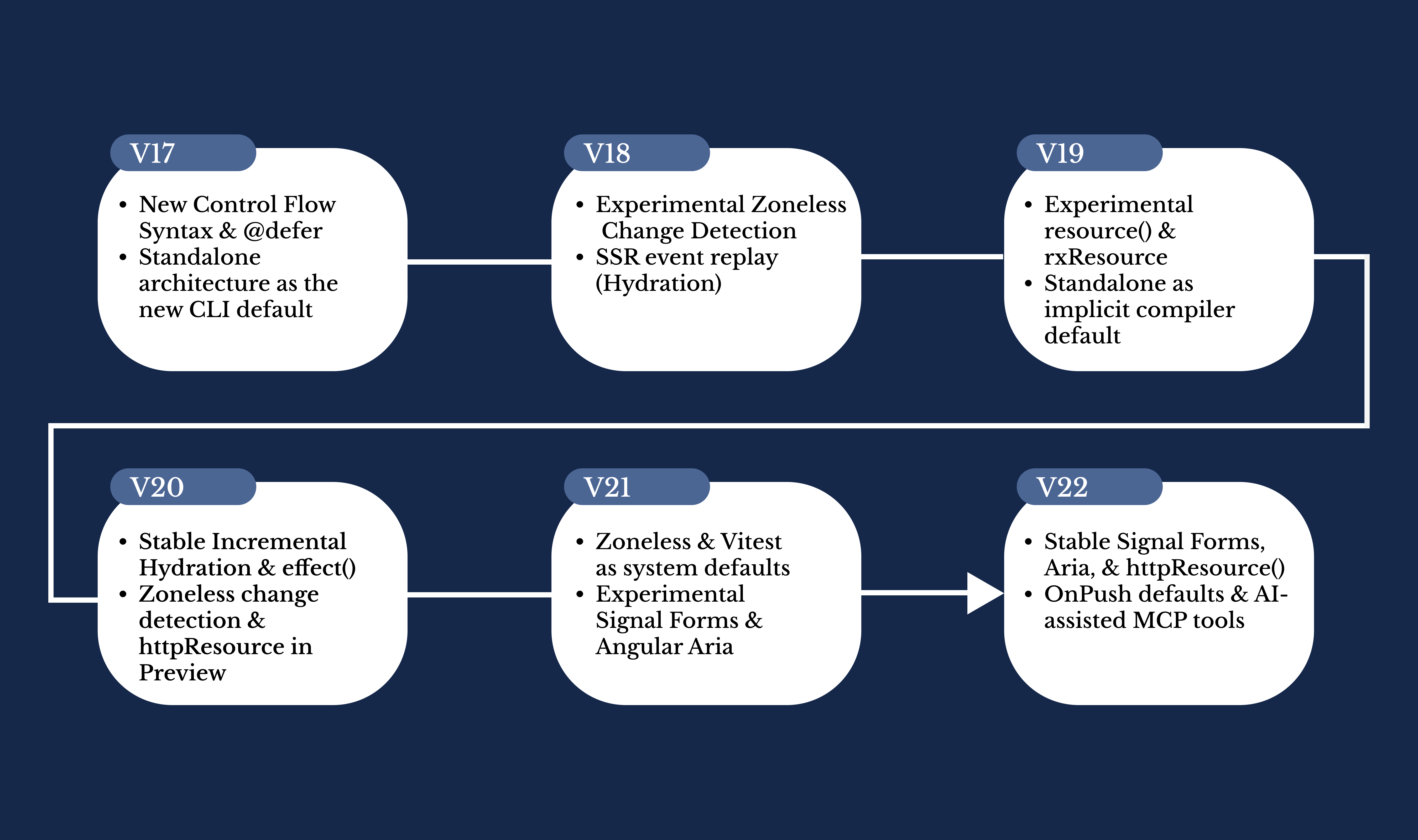
In V17, foundational shifts like the new control flow syntax and standalone CLI defaults were introduced, followed by experimental zoneless change detection in V18 and the debut of reactive resource APIs in V19. The framework's progression accelerated with V20's stabilization of incremental hydration, paving the way for V21 to establish a zoneless runtime and Vitest as system defaults. This multi-year development arc finally reaches maximum maturity in Angular 22 with the full stabilization of Signal Forms, out-of-the-box OnPush performance defaults, and integrated AI-assisted MCP tooling.
This article outlines the strategic implications of the Angular 22 release. We analyze the transition to a "Signals-first" architecture and the introduction of integrated AI tooling, demonstrating how these advancements may reduce technical debt and accelerate secure development cycles.
Transition to a Signals-First Architecture
Historically, Angular applications have relied on the global state-checking mechanism (Zone.js) and highly capable but complex external libraries (RxJS) to manage data flow. Zone.js operated by monitoring all asynchronous events (such as network responses or user interactions) and re-evaluating the entire component tree to ensure the UI was synchronized. Although robust, this "global check" approach, combined with the steep learning curve and overhead of managing simple state via RxJS Observables, introduced performance bottlenecks and cognitive complexity in data-heavy financial applications.
Angular 22 considerably matures the Signals-first architecture, establishing it as the new standard. Signals are lightweight data wrappers that notify the framework exactly which localized piece of the UI requires an update.
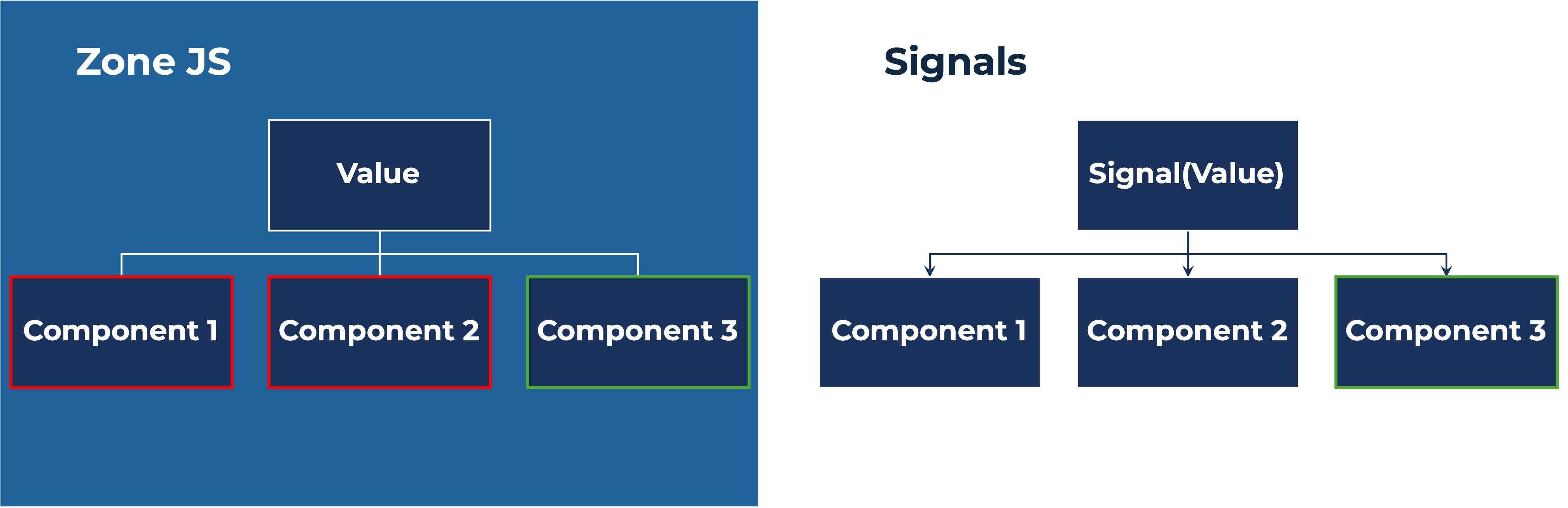
Figure 2 illustrates the behavior of the legacy Zone JS framework versus the new Signal-based framework. If a value is changed on an '$event', the legacy framework must check the whole tree structure within a tree (usually the whole application) for dependencies and to update dependent values. The Signals-based framework knows the dependencies already and only must update what is required, handing off control of these dependencies to the developer.
Furthermore, Angular 22 brings Signal Forms to full maturity. For financial institutions dealing with complex, deeply nested regulatory forms, this replaces heavy, Observable-based validation models with fine-grained, synchronous state updates. Consequently, enterprise applications become inherently faster, utilizing less memory, and may be considerably less prone to errors introduced by cognitive complexity overload.
The Mechanics of Signals vs. Legacy Reactivity
To better understand the productivity and performance gains of Angular 22, we examine the mechanical shift from RxJS-driven reactivity to the Signal-first paradigm more closely.
Historically, developers managing complex state (such as real-time trade execution platforms) relied heavily on RxJS ‘BehaviorSubject’. Although incredibly powerful for handling asynchronous event streams, RxJS is often over-engineered for synchronous UI state management. It requires meticulous subscription management to prevent memory leaks. Moreover, when an RxJS stream updates, Zone.js is triggered, initiating a top-down traversal of the component tree to check for potential changes.
Angular 22 simplifies this cognitive load by introducing four core, natively integrated reactive primitives:
1. Writable Signals ('signal'): The foundational reactive value. Unlike a variable, a signal notifies the framework the exact moment its value changes.
2.Computed Signals ('computed'): Derived state. These are inherently lazy and memoized (i. e., they only re-calculate when their specific dependency changes, and only if the UI actually requests the value).
3. Effects ('effect'): Operations that run automatically when one or more signal dependencies change, ideal for triggering isolated side effects without complex RxJS operator chains.
4. Resource API ('resource' / 'httpResource'): The newly stabilized standard for asynchronous data fetching. It bridges the gap between traditional Observables and Signals, allowing developers to manage complex network requests and race conditions as native Signals, completely removing the need for boilerplate subscription management in the UI layer.
Consider a common enterprise scenario such as calculating a dynamic brokerage fee based on a user's inputted trade value. Figure 3 displays a code snippet for a small implementation based on the legacy RxJS library on the left and an implementation employing a Signals-based approach on the right.
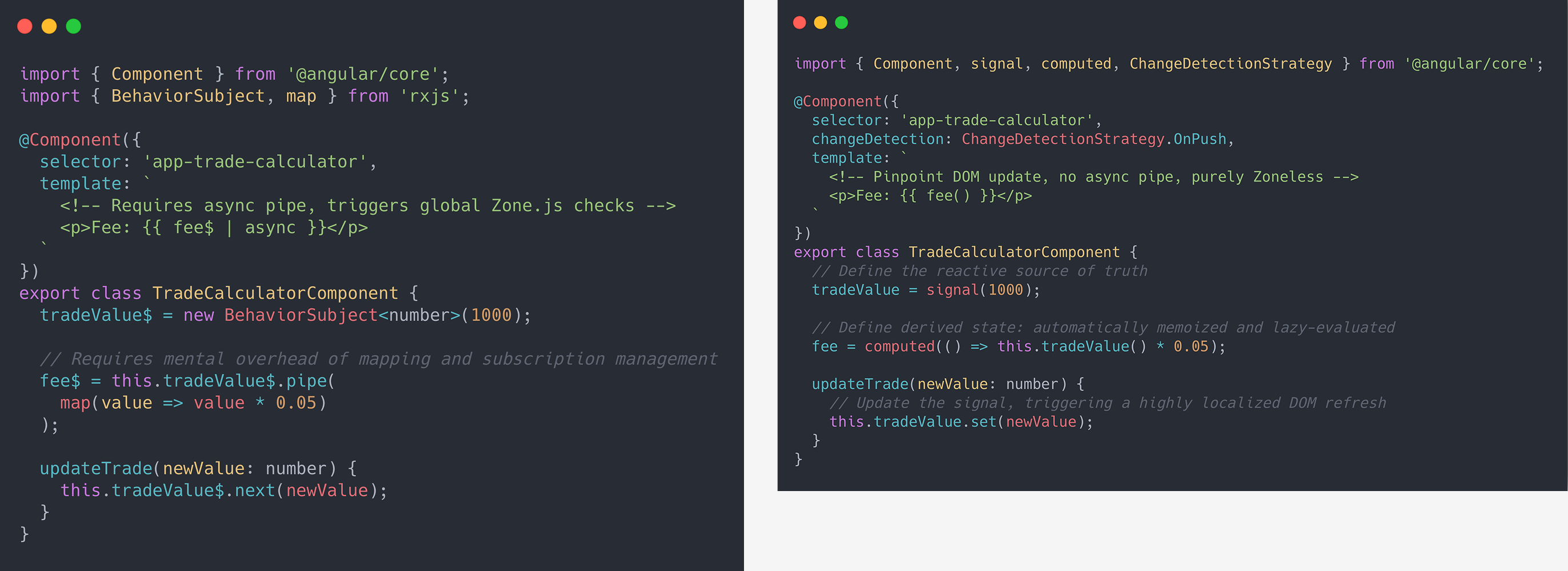
For the developer, the Signal implementation is entirely synchronous and reads like standard JavaScript. There are no subscriptions to manage, no 'pipe' operators to chain, and no 'async' unwrapping in the template. For the framework, invoking 'this.tradeValue.set()' bypasses Zone.js entirely. Angular 22's renderer is notified exactly which node in the DOM corresponds to ‘fee()’, updating that isolated text node in microseconds without checking the rest of the application.
To fully grasp the performance gains, one must also look at the mechanics of the 'OnPush' change detection strategy. In legacy configurations, any minor interaction, such as a ticking clock or a single market price update, would trigger Angular to evaluate every component on the screen. 'OnPush' acts as a strict performance boundary, instructing the framework to entirely skip checking a component unless it receives explicitly new data or a localized Signal update.
By setting 'OnPush' as the new standard for all newly generated components in Angular 22, applications naturally prune the update tree. To ensure seamless backward compatibility for massive enterprise codebases, the framework provides an automated migration that explicitly tags older components with 'ChangeDetectionStrategy.Eager' (the new, highly visible alias for legacy "check always" behavior). Therefore, by migrating to a 'zoneless' approach and establishing strict change detection boundaries, the framework no longer requires guessing what has changed.
Employed in a large-scale enterprise project, this mechanical shift drastically reduces boilerplate code, eliminates a massive category of memory leak bugs, and guarantees deterministic rendering performance.
Angular AI-Assisted CLI Tooling MCP
Current Gap between AI Velocity and Enterprise Reliability
Artificial Intelligence, specifically Large Language Models (LLMs), has drastically altered the landscape of enterprise software development. Development teams are generating code at an unprecedented pace. However, especially in highly regulated and complex environments, cracks are beginning to show.
While code generated by AI may look plausible on first inspection, it frequently introduces subtle architectural bugs and technical debt. This is primarily driven by hallucinations and context deficits. The AI may confidently suggest outdated or incorrect API usage and the context window of current AI tools is still simply too small to encompass large scale financial applications comprising hundreds of interconnected modules.
When applied to Angular development, this often results in an AI generating legacy code, like outdated RxJS patterns or Zone dependencies rather than adhering to the modern and highly performant Signal-first architecture outlined in the first half of this article.
A common mitigation strategy is to introduce a rule set the AI must follow, such as Angular's recommended patterns, project structure, and coding standards. The Angular team provides ready-to-use rules files for different AI-enabled integrated development environments (IDEs). These represent guard rails for the AI and may improve code generation; but critically, they don't guarantee compliance.
Double Guardrails for AI Code Generation
To address this compliance gap, the Angular framework has introduced a standardized solution. Beginning in late 2025 and maturing fully in Angular 22, the Angular Command Line Interface (CLI) natively integrates a Model Context Protocol (MCP) Server. Rather than relying on static and potentially outdated training data, the Angular MCP server allows the AI to dynamically query the framework itself. This creates a "double guardrails" protocol: enterprise rules tell the AI what to do, and the Angular MCP Server verifies whether it actually did it using the framework's native compiler and logic.
In this release, Angular categorizes its AI integrations into actionable "Tools" and overarching "Agent Skills." Instead of relying on the AI to query fragmented documentation tools piecemeal, AI assistants now utilize consolidated Agent Skills to inherently understand and enforce modern framework standards.
The Angular CLI exposes specific tools to the AI, including:
- 'angular-new-app' (Agent Skill): Intended for project inception, this skill guides the AI assistant through configuring a modern, local environment ready for Angular development. It restricts the AI when scaffolding applications, preventing the accidental generation of legacy boilerplate.
- 'angular-developer' (Agent Skill): This comprehensive skill consolidates capabilities like documentation retrieval and best-practice analysis. It acts as an always-on guardrail, utilizing "progressive disclosure" to dynamically feed the AI official 2026 architectural patterns without overloading its context window.
- 'onpush_zoneless_migration' (MCP): A framework-approved refactoring tool the AI can trigger directly via the CLI to safely and deterministically upgrade legacy components to modern zoneless standards.
- 'provideWebMcpTools' (API): A newly stabilized API that allows developers to register explicit, state-backed tools directly to the browser ('navigator.modelContext'). This grants local AI agents secure, read-only access to the live Signal state of an enterprise application, bypassing brittle DOM-scraping techniques.
Conclusion and Outlook
Angular 22 is not a disruptive rewrite, but rather a maturation of the framework. By finalizing the Signals architecture and introducing secure AI tooling integration, it provides enterprise IT departments with a robust, highly performant foundation. These changes ultimately translate to lower maintenance costs, faster feature delivery, and applications capable of handling the stringent performance requirements of the financial industry.
Looking beyond the immediate release, the integration of MCP into the localized development workflow offers compelling security advantages. By allowing AI to run static analysis directly against the framework's native tooling before code is ever committed, organizations can build automated, AI-driven shields. Much like how AI has been utilized to detect vulnerabilities in large systems like the Linux kernel, the Angular MCP can serve as a localized defense mechanism, proactively checking against client-side logic flaws and data exposure vulnerabilities before threat actors have a chance to exploit them.