We bridge the gap between mathematical theory
and practical business solutions.
In a marketplace defined by negative rates, crypto-volatility, and the ongoing regulation, legacy models are replaced by new approaches.
Our practice deploys rigorous stochastic calculus, machine learning calibration, and ECB-compliant validation frameworks to transform raw data into actionable intelligence.
Consult with a Quantitative Expert
Whether you require precise derivative valuation for vanilla swaps or path-dependent exotics, our models are calibrated to the bleeding edge of market dynamics. We bridge the gap between theoretical elegance and trading floor reality.
We move beyond the constraints of constant volatility.
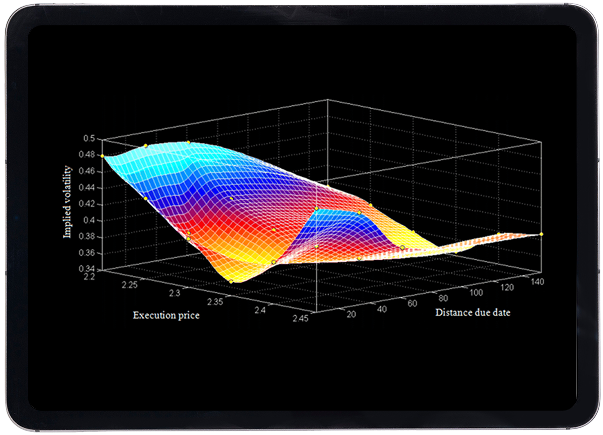
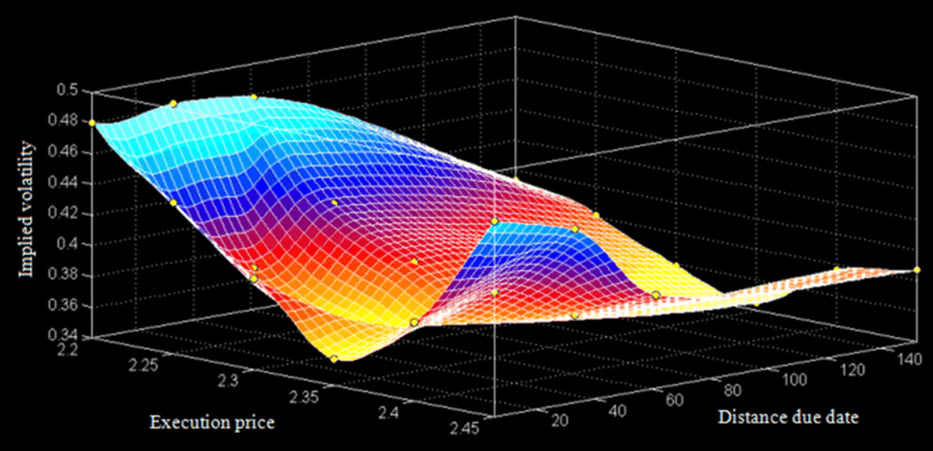
Our library includes Heston and SABR models calibrated to capture the volatility smile and skew essential for FX and Rate derivatives. For complex exotics, we implement Local-Stochastic Volatility (LSV) frameworks that simultaneously fit market prices and forward dynamics
We are also at the forefront of Rough Volatility implementation, utilizing fractional Brownian motion to model the 'rough' behavior of intraday volatility surfaces more accurately than standard diffusions."
Theory meets practice in our computational engine.
We deploy American Monte Carlo simulations using Sobol sequences (Quasi-Monte Carlo) to ensure faster convergence for high-dimensional problems. For path-independent structures, we utilize Finite Difference Methods (PDE) solvers. Crucially, we leverage Adjoint Algorithmic Differentiation (AAD) to calculate full sensitivities (Greeks) in real-time, providing the instant feedback required for active trading desks."
Trust, but verify.
Our IPV service provides the independent challenge required by regulators and auditors. We perform rigorous Consensus Pricing checks and calculate Additional Valuation Adjustments (AVAs) to satisfy Prudent Valuation standards, quantifying market uncertainty and model risk directly in the P&L.
Valuation extends beyond the instrument to the counterparty.
We calculate the full family of valuation adjustments (xVA), including CVA (Credit), DVA (Debit), and FVA (Funding), incorporating the cost of capital and collateral constraints. Our framework simulates potential future exposure (PFE) profiles to manage the 'tariff effects' and funding spreads of a volatile marketplace."
Modern risk management is no longer a monolithic compliance
exercise.
It is a multi-dimensional challenge requiring specialized
quantitative
frameworks for every threat vector.
We move beyond standard Value-at-Risk (VaR) to implement Expected Shortfall (ES) frameworks that capture true tail risk, ensuring full compliance with the Fundamental Review of the Trading Book (FRTB).
Our approach includes Deep Hedging strategies powered by reinforcement learning to manage transaction costs in volatile markets, and Rough Volatility modeling to price path-dependent risks more accurately than traditional diffusion models. We help you navigate the P&L Attribution Test (PLAT) to preserve your internal model status.
Default risk is rarely isolated. We deploy Heterogeneous Graph Neural Networks (GNNs) to model the complex web of interdependencies between borrowers, suppliers, and financial institutions.
By moving from static tabular models to dynamic network analytics, we uncover hidden contagion risks.
Our DeepCreditRisk frameworks offer symmetry-aware modeling for transaction data, all while maintaining Explainable AI (XAI) standards (SHAP/LIME) to satisfy the regulatory 'Right to Explanation'."
In an era of instant payments, end-of-day reporting is obsolete.
We build Intraday Liquidity Optimization engines using Machine Learning to forecast cash flows with granular precision. Our models utilize LSTMs (Long Short-Term Memory networks) to predict intraday liquidity needs and stress-test your survival horizons against ILAAP requirements. We transform liquidity from a constraint into a strategic asset."
We bring quantitative rigor to Non-Financial Risk (NFR).
Our practice applies Extreme Value Theory (EVT) to model the heavy-tailed distribution of cyber losses and operational failures. We help firms quantify Cyber Risk exposure in financial terms, enabling optimized insurance purchasing and capital allocation. Our frameworks integrate seamlessly with your existing GRC platforms to provide a unified view of resilience."
Validation is the immune system of your risk architecture. We provide independent, 'effective challenge' validation services that meet ECB TRIM and SR 11-7 standards. From conceptual soundness review to outcome analysis and stress testing, we ensure your models are robust, stable, and transparent.
As algorithms evolve, so must validation.
We offer the industry's most advanced assurance framework for Generative AI and LLMs in finance. Our testing protocols validate against the EU AI Act, detecting bias, hallucination, and drift in RAG architectures.
We deploy Explainable AI (XAI) techniques (SHAP/LIME) to 'open the Black Box,' ensuring that even the most complex Neural Networks meet the 'Right to Explanation' required by supervisors."
Protecting your capital requirements through rigorous testing.
We specialize in the independent validation of Pillar 1 regulatory models, including IRB (Credit Risk) and IMA (Market Risk). Our methodology is strictly aligned with the ECB Guide to Internal Models (TRIM), covering everything from data lineage to margin of conservatism (MoC). We also validate ICAAP/ILAAP stress testing frameworks to ensure resilience under the most severe economic scenarios."
Applying quantitative rigor to financial crime.
We validate AML Transaction Monitoring systems and Sanctions Screening logic (fuzzy matching) to reduce false positives without compromising detection risk. Our statistical testing of 'below-the-line' scenarios ensures your thresholds are tuned to the optimal balance of efficiency and compliance, satisfying the scrutiny of financial intelligence units and auditors."
Moving from manual review to 'Validation as Code'.
We help firms implement Continuous Validation pipelines that integrate with your DevOps stack. By automating regression testing, performance monitoring, and documentation updates, we reduce the cost of compliance and ensure your Model Inventory is always a true reflection of your live risk environment. This is Model Risk Management for the cloud era."
We bridge theory and practice through code. Our team integrates Python data stacks, C++ pricing libraries, and Cloud-native computing to deliver real-time risk insights.
We leverage Adjoint Algorithmic Differentiation (AAD) for lightning-fast Greek calculations and Machine Learning for intelligent calibration.
State-of-the-art models are worthless if they cannot be deployed. We don't just deliver research papers; we deliver production-ready code.
Our implementation practice bridges the gap using Python for rapid prototyping and C++ for high-performance pricing engines. We deploy Cloud-native risk grids (AWS/Azure) capable of scaling to millions of simulation paths, and leverage Adjoint Algorithmic Differentiation (AAD) to calculate real-time sensitivities (Greeks) for complex xVA desks. We ensure your risk infrastructure is not just theoretically sound, but computationally sovereign
True resilience requires understanding. Unlike 'Black Box' vendors who hold your data hostage, we operate on a 'White Box' philosophy.
We provide full source code delivery and dedicated workshops to train your internal quants on the models we build. From 'Python for Finance' masterclasses to deep dives on Stochastic Calculus, we ensure your team owns the intellectual property and has the capability to maintain it long after our engagement ends.
Global standards, local precision. While we operate globally, we specialize in the specific requirements of the DACH region.
We ensure your credit risk models align strictly with FMA Minimum Standards for foreign currency loans (FXTT) and repayment vehicles. Our ICAAP frameworks are calibrated to meet OeNB stress testing guidelines, ensuring you are prepared not just for Basel IV, but for the specific scrutiny of local on-site inspections.
The risk landscape is evolving faster than the regulation.
We help you stay ahead by integrating Climate Risk scenarios (physical and transition risks) directly into your PD/LGD frameworks using NGFS scenarios. Furthermore, we deploy Explainable AI (XAI) techniques to validate Machine Learning credit models, using SHAP values to ensure algorithmic transparency that satisfies the 'Right to Explanation' and upcoming EU AI Act requirements.